Pageviews from the past week

Friday, 15 April 2011

Incognito Image of the Infinite

This Palm Sunday, I will be sent to Coventry to deliver preach the following sermon. The Westfield House maintenance staff informed me that 'to be sent to Coventry' is a British colloquialism for  'not talking to someone, or ostracising someone.' I hope there isn't some joke going on here.

http://www.phrases.org.uk/meanings/sent-to-coventry.html


Text: Phil 2:5-11, John 12:12-19

+In the Name of Jesus+

            Jesus entered Jerusalem riding on the praises of the nation. For some, he represented a powerful political revolutionary. He had the potential to wrest Israel from the tyranny of the alien Roman authority. For others, Jesus’ religious deeds worked just the wonders that they wanted to see. Some in the Palm Sunday crowd perhaps had worked alongside Him as a craftsman or met him whilst fishing in the Sea of Galilee. Others probably joined the Palm Sunday horde because that they had heard of a plot to kill Jesus. They had heard about Jesus, or might have even met Jesus, and maybe some of them had been healed by Jesus. But there is more going on here than meets the eye!
            Sometimes, when we desire to accomplish certain tasks, our identity can get in the way. For example, if some of you try to enter the Royal Wedding next week, your identity may be an obstacle to securing a front row seat. Is someone here that actually does have an invitation? One has to be in the right circle of friends to enter such high profile event. But, it works the other way around as well; the rich and famous don’t necessarily have an easy time at making in the common realm. If William and Kate had strolled into service this morning, I am sure that we would have greeted them with a few stares. Leaders may have a difficult time getting out among their people.
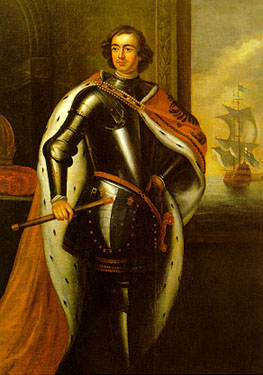
            Such an obstacle has led more than a few of the rich, famous, or powerful to go undercover seeking out the life of the hoi polloi, the masses. One case in point is the 17th century czar Peter the Great, well, he hadn’t become Great yet. Leadership fell upon Peter at a time when Russia sat in a pretty backward state of affairs in comparison with rapidly modernizing Europe. Therefore, Peter temporarily relinquished his public service as czar and went incognito through Europe. He put on a servant’s cloths for a time, while he sought learning in the arts, modern ship building technique, clothing style, military strategy, and city design. Had other countries known his true identity, they may have been less willing to share this information. Or, his life may have been in danger.
His journey carried him through much of present day Holland, where we worked on the docks and studied ship building. He also visited much of present day Germany, and Austria. But what you may find even more interesting is that he studied city planning very close to home, in the then young city of Manchester. I don’t know, but he may have even past near this very area. It should be no surprise that Peter’s incognito study of Western Europe helped inaugurate a renaissance in Russian life. As a result of his brief period of incognito work, he was exulted for posterity. We still honour him for his creativity with the title the Great.
When we look at the Jesus of our Palm Sunday reading, we need to realize that he is under disguise. He is no mere political revolutionary, religious guru, or simple tradesman. He is the LORD of hosts, the Holy One of Israel. But this raises a number of problems, and this is where Paul picks up in today’s Epistle lesson. The problem presented is one which all of humanity must grapple with. God is infinite; God is eternal, omniscient, holy, and therefore inaccessible to sinful man. Humanity on the other hand, in the words of Paul, is humble. Which means that humans are bound to sin and suffering, and condemned to death. How does a humble person, a sinful person, such as you or I approach the exulted LORD? This is the problem.
The key to our problem and the key to bridging the gap between sinful man and holy God is Christ. The story of Christ, doesn’t begin with a Bethlehem stable. It goes into eternity, or as Solomon writes of Christ, “The LORD brought me forth as the first of his works, before his deeds of old.” Christ shares in the eternal godhead as the second member of the Trinity. The Athanasian Creed confesses, “He is God, begotten from the substance of the Father before all ages.” Paul states, Christ has eternally been in the form of God. In every way, he shared equality with the Father.
 Instead of cherishing his Divine power and splendor, Christ relinquished them for a time. He went incognito, or became incarnate, in order to change the fortune of the entire human race. Why incognito? It was by taking human flesh, the same human flesh which you can pinch and grab a hold of, that Christ could pay for the sins which you have committed in the same flesh. Christ became fully human, but in a rather unique way. While sharing in the likeness of men, he alone demonstrated the perfect obedience required by God’s holiness.
Christ’s obedience compelled him to enter Jerusalem on Palm Sunday. It is required by the law. Exodus 23 states, “You shall keep the Feast of Unleavened Bread. As I commanded you, you shall eat unleavened bread for seven days at the appointed time in the month of Abib, for in it you came out of Egypt. …Three times in the year shall all your males appear before the Lord GOD.” This meant, that Jesus, in perfect obedience had to journey to Jerusalem for the Passover. He was compelled by the Law.
While being in the form of God, Christ humbled himself by taking the form of a servant. Jesus appeared to the senses to be middle aged man, of Jewish descent. But he claimed to be as old as eternity. Jesus’ claims were a real scandal. Paul tells us that in this man Jesus was the fullness of God: eternity, omniscience, and holiness. The infinite had gone incognito by becoming human. This claim posed a huge challenge to the religious thinking of the day. It amounted to blasphemy. If God was exulted and all the rest, then it would be paradoxical for him to enter into the sin laden world of humans. Surely God’s presence would be accompanied by angelic armies, loud trumpets, or fire. Instead, on Palm Sunday God reveals himself in Jesus whose obedience carries him to Jerusalem so that he can fulfill the Law’s required Passover celebration.
 His obedience carried him further, to the point of death, death on a cross. If you were a faithful Jew, hearing the salvation story for the first time, you might gasp here. The logical conclusion of the argument is the God died. God did not even die a peaceful or glorious death; his death was brutal and inglorious. A good Jew would know the law, “Cursed is everyone who is hanged on a tree.” How could God be cursed? It is not God who is cursed, but you. Christ’s did not enter Jerusalem on Palm Sunday for His own sake. He did it for you.
Jesus rode into the city through a crowd singing all the right words, “all glory, laud, and honor, to you Redeemer, King.”  Yet, their intentions were all wrong and their city was in a state easily described as a social mess. Five days later, this same city would have the audacity to kill God. Our world is also is a social, sinful mess, sometimes more than we would like to admit. Each day, we are caught up in cutthroat competition, which promotes rivalry and self-interest. Rivalry leads to conceit, conceit leads to idolatry, and idolatry means disobedience to God’s law. Christ entered Jerusalem to redeem sinful Jerusalem and to die on behalf of your sin.
This Palm Sunday is different from the first. Unlike the first crowd, you know the outcome. You know that Easter dawn awaits you on the third day after Good Friday. Today you enter Passion Week with Christ. Christ, who was the icon of the Father, bridged the gap between himself and you by becoming man. Christ went incognito in order to conform you to His image. As a baptized child of God, you share in Christ’s perfect obedience. Therefore, you are able to treat each other in a different light. Paul exhorts the Philippians “Have this mind among yourselves, which is yours in Christ Jesus.”  Palm Sunday means that Christ acts incognito through you; he inspires you to thoughts of love and actions of affection and sympathy. You no longer are caught up by cutthroat rivalry, self interest, or conceit. This Palm Sunday, you are not bystanders, you relive the events of Holy Week as obedient servants.  
Peter the Great left his position as czar of Russian in order to bring back knowledge and learning to his native Russia. He took the form a servant in order to better the lives of his people. Christ left his position of Divine power and splendor in order to redeem your life. He sanctified the social nightmare left in the horrible wake of sin, and he carried it to the cross. Christ’s humble obedience becomes your obedience, which leads you to pick up your own cross and follow Him.
To close today’s sermon, I want to ask a question of you. I ask this question because it is often asked of Christians around Easter. “How can sinful humans can actually know anything true about God and eternity?” or “How can you Christians be sure that you have it right?” Again, the answer is Christ. To know anything about God, he must reveal it to us. As Jesus says to Pilate on Friday morning, “For this purpose I was born and for this purpose I have come into the world--to bear witness to the truth.” Nowhere does God make a better revelation of the truth than at the cross. He died as a revelation of His condemnation of sin, as well as a fulfillment of His promise to redeem humanity. This revelation sets the context for the Holy Week celebration; we regret our sins, and therefore cry out “Hosanna!” But we also rejoice in the Holy Son of God who went incognito to win our redemption.
Now may the Son of God, who surpasses all glory and understanding, bless your journey to the cross and unite your hearts in love.
Amen
Verbum Domini Manet in aeternum+

Monday, 10 January 2011

No Free Lunch- Even for the Lutherans

It seems to me that the economic axiom “there is no such thing as a free lunch” can also provide the springboard for exploring the spiritual economics. As Lutherans we appreciate, and rightly so, Paul’s words “For the wages of sin is death, but the free gift of God is eternal life in Christ Jesus our Lord.” Tragically, we can become comfortable with our ‘free gift.’ Therefore, Christians often run the risk of spiritual indifference, or even moral licentiousness under the assumption that we have been/will be forgiven. The free gift of God becomes a cheap gift. Dietrich Bonhoeffer, 20th century Lutheran theologian, puts it this way:

Cheap grace means grace as bargain-basement goods, cut-rate forgiveness, cut-rate comfort, cut-rate sacrament; grace as the church’s inexhaustible pantry, from which it is doled out by careless hands without hesitation or limit. It is grace without a price, without cost. (Discipleship, p. 43)

The truth is that cheap grace is no grace at all. There is no grace without suffering, there is no grace without the cross, and there is no grace apart from Jesus Christ. Authentic grace is quite costly; it costs people their lives, as it did our Lord Jesus Christ His. The grace that we experience is anything but cheap, “You were bought with a price” (1Co 6:20).

Believing in cheap grace is believing in a fantasy. Living as if one does not need repentance, avoiding the sacrament, embracing sin, and avoiding the word all fall under the category of cheap grace. Faith of this sort, it no faith at all, and does not save. “For it is by grace you have been saved, through faith--and this not from yourselves, it is the gift of God” (Eph 2:8). Costly grace, that grace which gives eternal life, comes from the cross and is delivering in the church to sinners.

            Costly grace will cost you your life, as Luther's Catechism says:

What does such baptizing with water indicate? It indicates that the Old Adam in us should by daily contrition and repentance be drowned and die with all sins and evil desires, and that a new man should daily emerge and arise to live before God in righteousness and purity forever.

The miracle, as Bonheoffer puts it, is that the death of costly grace “thereby makes people live” (p.45). From this death, life emerges, we emerge in Christ. It is the death of sin and spiritual fantasy. In our baptism we become awakened to reality, awakened to the fullness of our humanity as God intended for us to experience. It is grace that God has revealed to us the path of salvation, through His Son Jesus Christ. During this Epiphany we celebrate this revelation of costly grace which has given us life, made us fully human, and united us to Christ. In this revelation we dine on the meal that is not free, but costly, sumptuous, and exquisite. It was bought at the high price of our Lord’s body and blood.

Blessed Epiphany!

Tuesday, 7 December 2010

A Few thoughts at the Termination of Term

The Michaelmas season has come to an end, and a new church year has begun. Here at Resurrection Lutheran Church, we are enjoying our fellowship as we light the Advent candles in expectation of the coming Christmas. Last week, following an excellent Compline prayer service, we decorated the sanctuary and then partook in a pot-luck. The food was second to none.

I would like to thank everyone that participated in the Westfield community this fall, the students, the faculty, the staff, friends, visitors, and passers by. I appreciate your tacit commitment to dealing with our absurdities. It would be remiss to neglect to extend my gratitude to all those who have supported us from abroad: especially those from my home congregation (St. John's, Ladysmith) and all those at the seminary at Fort Wayne. You know who you are.

One noteworthy highlight from this fall was a forum at which Archbishop Rowan Williams spoke on the topic of New Atheism.
While no conclusions were reached (predictable), I do think that the Archbishop's adroit theological skill had its chance to shine. No, I am not asserting that Willams is by any means 'orthodox.' But I do believe, that he presented the faith in a cogent and well constructed manner. While he as willing to accept the statement of the hard Post-Modernist, " Every intellectual position we hold is a coping mechanism for getting through a complex world," he was critical to respond "This says nothing of a religion's truth-value...what makes religious language so unique is that it invites darkness and is willing to risk all things on search for the truth." Willams aptly exposed the folly of the new-atheists' desire for a religion-less world. "As far as I see it, people have always been religious and don't particularly seem as if they are going to change" [Paraphrase]. Well put Rev'd Father.

Feeling dejected from not enjoying the lecture? I have included it here for your pleasure and enrichment.
http://www.archbishopofcanterbury.org/3048

Wednesday, 27 October 2010

Stones and the Sublime

And as he came out of the temple, one of his disciples said to him, "Look, Teacher, what wonderful stones and what wonderful buildings!"  And Jesus said to him, "Do you see these great buildings? There will not be left here one stone upon another that will not be thrown down."(Mk 13:1-2 ESV)
One of the great marvels of our Christian God is His character of presence. That is to say, he mediates himself to human beings in time and space. One can trace the Old Testament theology of presence, especially as it is connected to the Ark of the Covenant, the Tabernacle, and subsequently the great Temple of Solomon. All of these pale in comparison, or in other words are foreshadows of, the temple that “neither moth nor rust destroys and where thieves do not break in and steal” (Mt 6:20). The Christian life celebrates and embraces Jesus Christ as the eternal temple, the place of mediation between God and man. In fact, he is the personification of God’s presence.


Following His ascension, Christ left his disciples saying, “I am with you always, to the end of the age” (Mt 28:20). Christ is still with his Church. Believers still touch, receive, and commune with the body of Christ, albeit through the mediated presence of the Word and sacraments. Furthermore, the Word and sacraments find their home within the architecture the church's structure. It is therefore of chief importance for the Christian to be cognizant of their physical surroundings; it is these that teach about the spiritual surroundings that are viewed only through eyes of faith.

Three seminarians, myself included, recently spent a day contemplating great works of architecture: The Stonehedge, Old Sarum ruins, Salisbury Cathedral St. Mary’s, and subsequently the Chapter house of St. Mary’s . While these later locations are distinctly Christian, the Stonehedge remains in clandestine obscurity.

Insofar as we celebrate the true temple of Jesus Christ, it is also edifying to study earthly temples. Stonehedge, for example, informs primarily about humanity. At this point, I would like to evoke Kant’s distinction between the Beautiful and the Sublime. The Beautiful, by way of definition, is that which is pleasing to the eye. It evokes admiration and gives pleasure. The Sublime on the other hand induces “an overwhelming loftiness or vastness” often tantamount to terror (http://csmt.uchicago.edu/glossary2004/beautifulsublime.htm).

Now, I believe that our little adventure appropriately demonstrates the boundaries of the Sublime and the beautiful. Its unknown origins contribute to the arcane character of Stonehedge. Experts are uncertain of its construction, its original architects (it was completed over a number of centuries) and the original purpose of the structure. Yet, thousands of tourists flock to the British country side each year to wallow in the shadows of these stones. For us, the lugubrious and forlorn weather multiplied the Sublime character impressed upon us.

If we had just seen Stonehedge that day, I am sure that we would have been left in quite a melancholy disposition, if not for it its Sublimity then for the mere fact that we were drenched. But, Wes being an adventuraous fellow directed us to the Old Sarum ruins- the archaic site of Salisbury. Serendipitously, and to our astonishment, the weather turned very nice. The swift breezes harmonizing with the sun quickly dried our clothes and warmed out spirits. We took this opportunity to have a bite to eat on the castle ruins.
Reinvigorated by the weather, we traveled to Salisbury Cathedral. This feat of architecture, with its imposing steeple, ominous statues, and Gothic pillars drove the viewer to sublime terror (incidentally, it began to rain again). Simultaneously,  the salvation story told in the stained glass, the music of the Choristers, and the baptismal font all evoked grand expressions of beauty. Attached to the Cathedral is the ‘Chapter House,’   containing yet another great testament to the Human Race: the Magna Carta. This document signed by King John in 1215 marked the beginning of limited monarchy and contains articles defending the church's and individual rights.


Despite frigid temperatures, chilling winds, and voluminous downpours; we persevered and admired these various British architectural endeavors. It is our prayer that the descendants of the same would honour their great heritage, and in turn worship the God that has showered innumerable gifts upon their country.

Blessed Jesus, whose Holy Temple gives eternal rest to our souls, may your Church always testify to the treasures which neither rust nor corrode. Build us as living stones upon your firm foundation fortified against all torrents of the devil and the world. We entreat you for those peoples scattered throughout this land who have wandered outside the protection of thy bulwark. Guide them into thy truth, our only hope and source of mercy.

Saturday, 9 October 2010

A Mad Tea Party

A family from Resurrection Lutheran Church hosted a Tea Party this afternoon as a fundraiser event for the handicap outfitting for the parish. The event was themed after Lewis Carol's classic, "The Mad Hatter Tea Party." It was mandatory that all come in a cap, optional was the dress as a character from the Alice in Wonderland story.


"The time has come," the walrus said, "to talk of many things; of shoes and ships and sealing wax and cabbages and kings."

The Luther Hall residents each represented the major story characters. Samuli, our dear brother from Finland deserves high commendation for his astute performance as the 'Cheshire Cat.' Joe and Wes, although they 'had their cake and ate it two' as Tweetle Dee and Tweetle Dum, really were no different than normal. Finally, we would be remiss to neglect the Queen of Hearts who by her cunning and bolstering of creativity inspired the concerted effort.

A good time was had by all, many of us wished we had worn more thermal clothing!

Saturday, 2 October 2010

Big Ten Mascot Goes International


Reports indicate that Wisconsin’s iconic badger, Bucky, was recently spotted in London. Political commentators are baffled by this events incredulity. It is speculated that Wisconsin state gubernatorial candidate, Tom Barrett, dispatched this figurehead in order to garner the support of the British Queen.

Shortly after his arrival in the capital city, escorts hosted the badger on a grand tour of the city.

While the tour included the staples: London Tower, Big Ben, Westminster Abbey, and the famous eye; he was also led through back streets on the south side of the river Thames. The toured delivered the real Cockney- unaltered Dickensian London: Oliver Twist, Mary Poppins, and Harry Potter were literally dancing in the shadows!

Bucky was pursued by a number of interested theologians. Close on his tail (no joke); they followed him to and fro. Determined to catch up with this super-star, they were glad when the badger took time to hear Even Song (in Wisconsin this is generally called Evening Prayer or Vespers) at the Abbey.
His ambassadorial mission was successful when the Royal Highness welcomed the badger to afternoon tea in the Buckingham palace.


 While the queen declined to take sides in Wisconsin’s political race, she awarded her visitor the highest honour. The royal guard marched in regal procession to the tune of ‘On Wisconsin.’

Way to Go Bucky!

Friday, 1 October 2010

Early Days

Recovering against the MRSA staph, this Lutheran Seminarian traveled toward the English sea-shore in order to find respite and recuperation. Yet, a protract journey lay in front of him. The distance between Minneapolis-St. Paul International Airport  and Deal, Kent (yes, this is the place we stayed) is not so easily traveled.

Joined by fellow seminarian Timm and his wife Hannah, we took a one-stop flight to London Heathrow via Reykjavik. The Icelanders were hospitable and this was a peaceful place to spend my first 8 hours as an International traveler...yet the day was far from over.

Once landed in Heathrow, and after much investigation we arrived at the Hertz-rent-a-car agency. After a few minor complications (45 min wait), we were on the road. If can call it that. Because driving in England is not comparable to driving in England. To begin with, all the rent-a-cars came with a manual transmission. Automatically, I would be disqualified. Fortunately, Timm (who now possessed an International Drivers License) was competent in this task.

And a formidable task it proved to be! For we had before us a 20 km drive right through the heart of London. I now know that taking to the London streets on a Saturday night is an activity avoided by even the most veteran London residents. Beyond the burgeoning congestion of the streets, we three nascent travelers, were competing with countless pedestrians enjoying the parties of Paddington and Camden.

Three hours later...we arrived at Luther-Tyndale where we stayed in their Hostel for itinerant Lutherans. By this time, my wounds were in desperate need of cleaning and our cohort likewise needed rest. Thanks to the brother of my dear friend Mattias, from South Africa, we were well cared for.


The next morning, the Luther-Tyndale congregation welcomed us to their Divine Service. Following service, they delighted us with a banquet celebrating the congregations youth: complete with dancing. This phenomena is something that I cant ever recall witnessing in the Midwest.

That afternoon, we had to travel to Cambridge (two hours north of London) before we could travel to Deal (two hours south of London). All this was so that we could drop-off a substantial portion of our Luggage. Up until that point, our small car was filled to the brink!

After a warm welcome by the Westfield Staff, we were on the road again. Over the river (Thames) and through the woods (Canterbury), we finally arrived at 2 Capstan Road. France was visible across the channel.
I came seeking respite and recuperation; the beauty of the region certainly afforded these . It was a blessed week that allowed me to prepare for the coming theological studies.